
Noun Abdelaziz
Advocacy Lead at the United Women of East Africa Support Team
Noun is a Advocacy Lead at the United Women of East Africa Support Team (UWEAST), where she works to uplift community voices and drive youth-centered initiatives. She also proudly represents UWEAST on the San Diego Refugee Communities Coalition’s Policy Council, advocating for policies that reflect the needs and strengths of refugee communities.
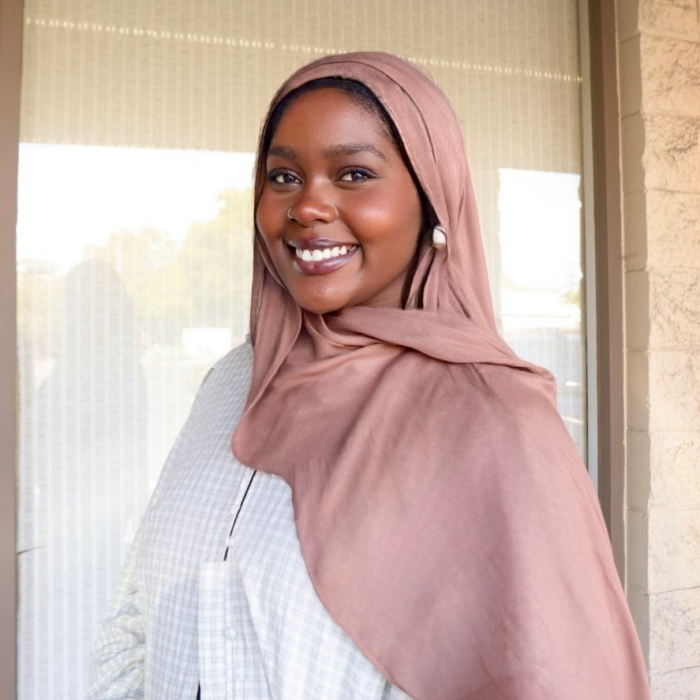
About Noun Abdelaziz
Noun Abdelaziz is a community organizer, health researcher, and Global Health Masters student at UC San Diego. With deep roots in public health advocacy, mental health education, and nutrition research, Noun brings both heart and insight to her work. As a Sudanese Egyptian immigrant and poet, she weaves her lived experience into every space she enters and creates connections that are both meaningful and grounded in culture.
Noun is a Advocacy Lead at the United Women of East Africa Support Team (UWEAST), where she works to uplift community voices and drive youth-centered initiatives. She also proudly represents UWEAST on the San Diego Refugee Communities Coalition’s Policy Council, advocating for policies that reflect the needs and strengths of refugee communities.
Over the years, her leadership has been recognized through several honors, including a nomination for the 2018 California Endowment Youth Awards, the 2019 National Philanthropy Day’s Outstanding Youth/Student Volunteer award, and the American Heart Association’s 2020 Student Scholar award. She was also highlighted by U.S. News & World Report as a “Citizen of the World.”
Whether she’s leading research with the UC San Diego Refugee Health Unit or showing up for her community through storytelling and advocacy, Noun continues to center healing, justice, and belonging in all that she does.
Noun Abdelaziz and the team will highlight the evolution, impact, and replicable community‑led model of the San Diego Refugee Communities Coalition (SDRCC). Presenters will share how SDRCC’s collaborative structure supports refugee communities through coordinated services, trusted messengers, data ownership, and an innovative funding model that strengthens both community partners and funders. The session will emphasize real‑world examples, statewide partnerships, frontline experiences, and sustainable program design, while also outlining practical solutions to common challenges such as funding sustainability, system fragmentation, and inequitable access. Solutions highlighted will include strategies for building long‑term community capacity that improve both service delivery and organizational resilience.