

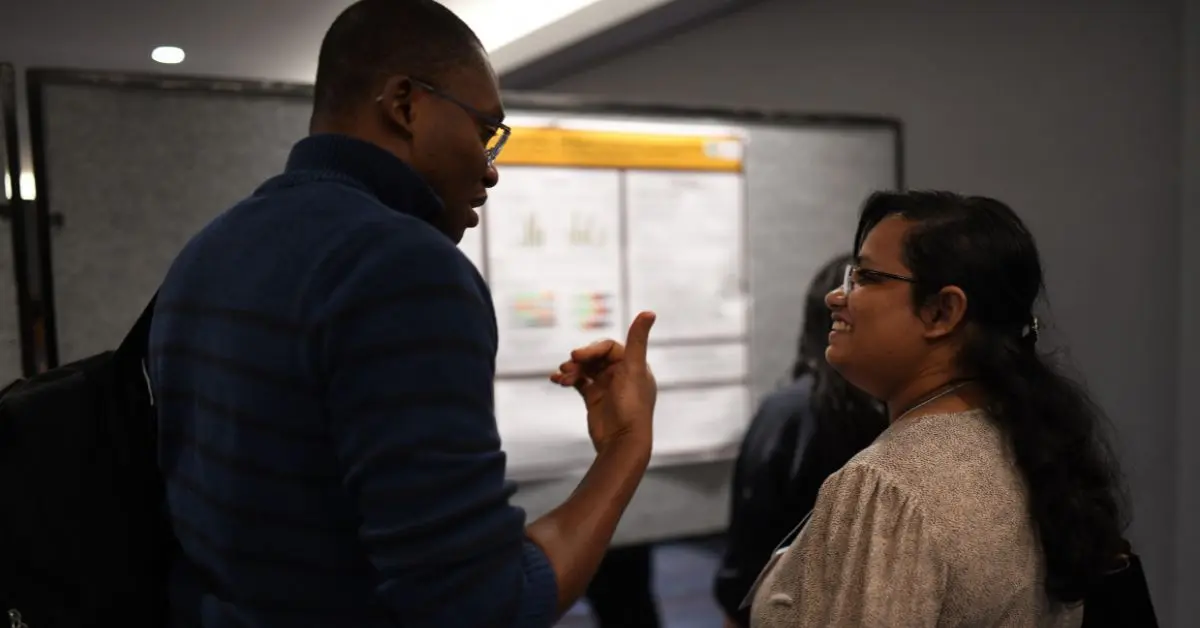
Abstract submissions are now open for the Society’s International Refugee and Migration Health Conference (IRMHC)*. IRMHC accepts abstract submissions for posters, 15-minute oral abstracts, and one-hour workshops or panel discussions. We are interested in a wide range of topics in refugee and immigrant health which are listed on our abstract submissions webpage. Attendees range from newbies in refugee and migration health to seasoned career professionals. Every year we receive hundreds of abstract submissions. Here are six tips from our reviewers on how to prepare a quality, competitive abstract that effectively showcases your important work.
*The Society previously offered our conference as the North American Refugee Health Conference. Same awesome conference, new more inclusive name!
1. Start with a Strong Research Design
Okay, so this first point isn’t exactly a tip that can be implemented at the abstract writing stage…but it’s worth noting for your long-term planning. An excellent research abstract depends on a well-designed study. Make sure when designing refugee and immigrant health research that you’re testing hypotheses, answering scientific questions, and following best practices for quantitative, qualitative and mixed methods studies. Need guidance on specific research methods? You can always reach out to the Society’s Research, Evaluation and Ethics Committee to request assistance.
If you’re submitting a non-research abstract, such as on health programming, promising or “best” practices, or program evaluation, you’re not off the hook. It’s helpful to know the process you took so that others can replicate but also make sure to incorporate rigorous outcomes assessments into your project design. You can have a great program that may or may not achieve its objectives (and either way might be worth learning from), but no one will know if there are no assessments. Our partners at Switchboard have published numerous resources on monitoring and evaluation for service providers.
And speaking of strong research or health programming….
2. Meaningfully Include People with Lived Experience
Key to a strong research design or health programming is meaningfully including people with lived experience as refugees and/or of forced displacement as co-designers and co-leaders. These voices should be included in each stage, from the study or health programming inception and design through to implementation, data collection, analysis, interpretation and publication. The Society’s Refugee Review Board provides free consultations on research and health programming proposals to ensure research and programming are inclusive of refugee voices.
The Society offers abstract submitters the ability to identify if co-authors have lived experience of forced displacement and resettlement (provided people give permission and feel comfortable disclosing this information). When finalizing accepted abstracts and choosing between abstracts with equal scores, the Society prioritizes those abstracts listing co-authors with lived experience. This is one small way we are trying to promote equity in research. It is essential that any co-authors with lived experience have had a chance to meaningfully contribute to the project and that if the abstract is selected, they will be one of the people presenting the abstract at the conference.
3. Form Partnerships Across Organizations, Disciplines and Geographies
This tip is relevant for all abstract submissions but is particularly important for submitted workshops/panels. Abstracts with author teams originating from different departments, organizations, disciplines, and/or geographical locations often score higher than abstracts from just one organization.
We’re proud that IRMHC has grown to welcoming over 1,000 participants from 45 U.S. states, seven Canadian provinces, and 19 other countries. One of IRMHC’s strengths that attendees find most valuable is its multidisciplinary nature and ability to help people connect and network with a diverse range of people.
The most competitive abstracts therefore feature insights from multiple places – be it several departments within one organization (e.g., the legal team, resettlement team, and the clinic), several organizations (e.g., a university, resettlement agency, community-based organization, and a healthcare clinic), people representing multiple disciplines (e.g., a physician, social worker, community health worker, and mental health professional), and/or people from multiple geographical locations – either within one region (e.g., state or province), across multiple regions (e.g., states, provinces) or across several countries.
Don’t worry…we still value insights and data from one organization or place, especially for oral abstracts and posters. But workshops and panels are especially strong when they bring attendees learnings that can apply in multiple settings.
4. Create Workshops that are Truly Practical and Skills-Building
Without a doubt, one-hour workshops/panels are the most coveted presentation slot at IRMHC. When creating your workshop proposal, the first step is to ensure that the topic merits an entire hour. If you are:
- presenting data
- focusing on just one program or research project
- promoting a particular clinical or community program as a best practice without rigorous outcomes evaluation to support that assertion
These would not fit as a workshop submission and would instead work better as a poster or 15-minute oral abstract (and the best practice example would need outcomes evaluation added, even for posters or oral abstracts).
Instead, workshops should include a review of multiple studies and literature or give a detailed overview of the topic. Presenters are expected to present currently accepted guidelines and/or suggested guidelines based on evidenced-based findings. Potential workshop presenters must demonstrate their subject matter expertise and ability to conduct the workshop by sharing details in the biography portion of the abstract submission.
Workshops and panel discussions should be interactive, engage with the audience and impart practical knowledge and skills relevant to conference attendees. Abstracts that include significant participant engagement are more likely to be selected. Proposing a workshop that is 45-minutes lecture and 15 minutes for questions and answers will not be competitive compared to a workshop where the audience works in small groups, completes simulations, or is otherwise deeply engaged in the material using adult learning best practices.
We love workshops and panels that focus on a range of topics – be it building clinical skills in a certain area, showcasing novel partnerships or programming in refugee and migration health, or facilitating a discussion with leaders in the field etc. Just make sure that whatever you propose will teach attendees something timely, new, evidence-based and valuable to their work.
5. Include Data and Only Submit Finished Work
Whether you’re submitting a research abstract or update about your health program, including data makes your abstract more competitive. For health programming this means including outputs and rigorous outcomes assessments (not just process) that inform the program or best practice recommendation you are making.
For research abstracts, this means ensuring that the final results are described. Abstracts with preliminary results or early/conceptual projects with results pending are unlikely to be selected. Include any new or innovative data on emerging trends in refugee health. Report as detailed outcomes as possible with actual numeric results and statistics (e.g. odds ratios) for quantitative studies, thematic analysis for qualitative studies, or a combination for mixed methods studies. Describe the sample size and measurement of outcomes. Consult a statistician if needed to review your results.
We are as excited as you are by the great work you’re doing. But if the timing just isn’t working out and your results aren’t ready yet, please don’t submit an abstract! You can always submit your work to next year’s IRMHC.
6. Follow The Required Format and Use Our Checklist
This might seem like a throwaway tip, but you’d be surprised by how many people forget to read the fine print before submitting their abstract to our conference. Every conference has their own set of criteria for abstracts. IRMHC is no exception, and we detail everything you need to know on our abstract submissions webpage. Stick to our specified word count and take special care with your title – our conference app has a character limit. Follow the headings specific to your presentation format (e.g., oral abstracts versus workshops). Spell out acronyms and check your spelling. Verify that your abstract offers new insights or updated information if you presented at previous International Refugee and Migration Health Conferences. We welcome repeat presenters but want to offer attendees new information that they haven’t seen in previous years.
It’s this attention to detail that shows us how much you understand what IRMHC attendees are looking for. And it helps our reviewers more easily assess the quality of your work. We’ve created this handy downloadable self-assessment checklist to help you review your abstract and meet each of our criteria. Don’t be afraid to also ask your colleagues or mentors to help review your abstract using the checklist.
We hope these tips help as you put together your abstract. We’re looking forward to reviewing your submissions!